Warehouse fire suppression systems
Warehouse fire suppression systems are mostly automatic sprinklers fed by a city main or a fire pump, backed by a fire alarm and portable extinguishers. Each has its own inspection cycle under NFPA 25. If you stack goods above 12 feet, or 6 feet for some commodities, you may also need a high-piled storage permit under IFC chapter 32.
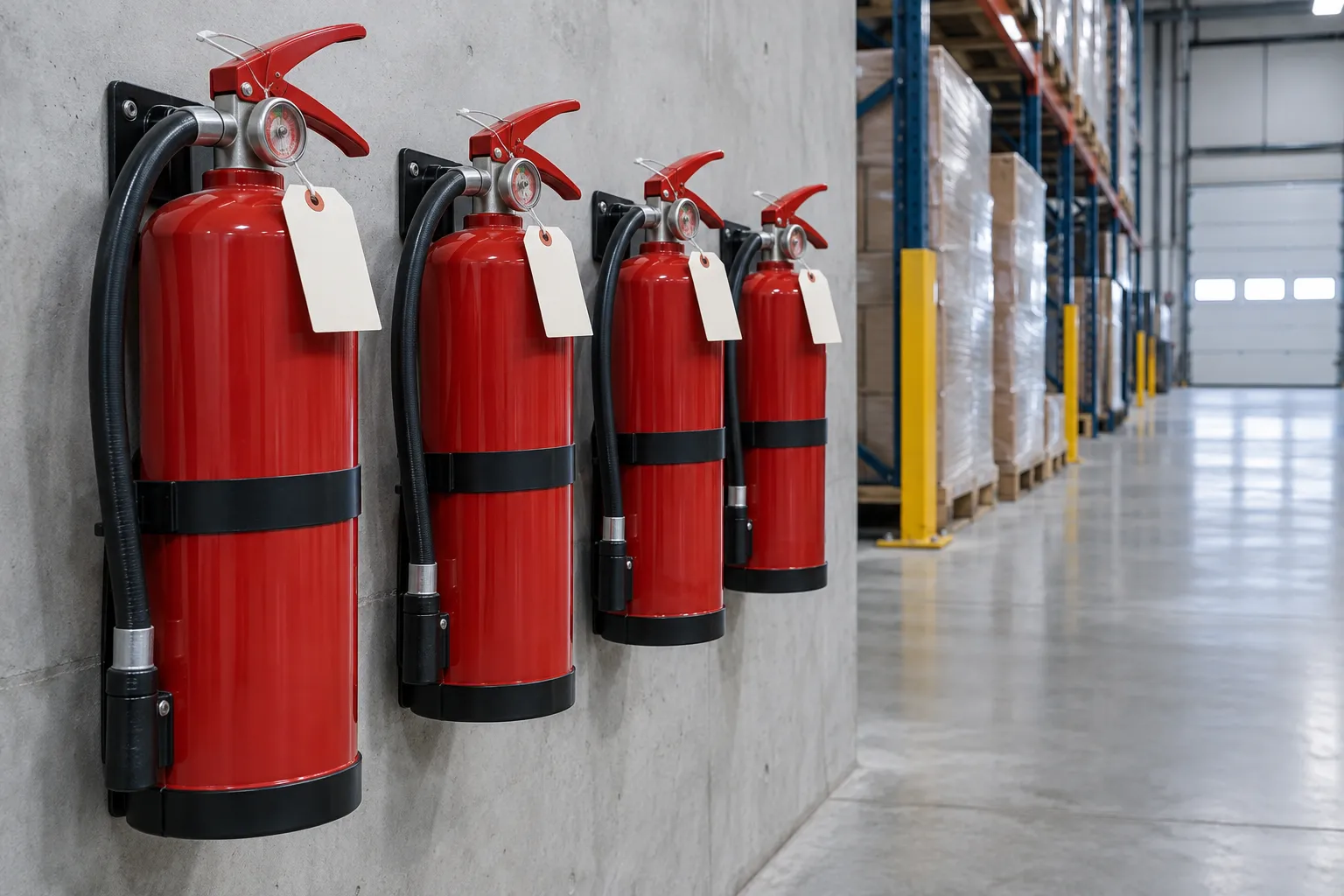
Systems in a typical warehouse
| System | Usual frequency | Who does it |
|---|---|---|
| Fire sprinklers | Weekly or monthly valve and gauge checks, quarterly alarm tests, annual inspection, five-year internal checks | Staff for visual checks; licensed sprinkler contractor for tests |
| Fire pumps | Diesel: weekly no-flow run of at least 30 minutes. Electric: monthly run of at least 10 minutes. Both: annual flow test | Staff for run tests; pump contractor for the flow test |
| Fire alarms and waterflow monitoring | Inspect and test at least yearly; confirm with your fire marshal | Licensed alarm company |
| Fire extinguishers | Monthly visual check; annual maintenance with a current tag | Staff monthly; licensed company yearly |
| Emergency lighting and exit signs | Confirm the monthly and annual test routine with your fire marshal | Facility staff or electrician |
| Backflow preventer on the fire line | Often once a year; set by your water utility | Certified backflow tester |
Compliance calendar
Every month
- Look at every extinguisher and forklift charging area extinguisher.
- Check sprinkler gauges and that control valves are open and locked.
- Run each electric fire pump for at least 10 minutes and log suction and discharge pressure.
- Measure storage heights and aisles against your approved plan.
Every week
- Run each diesel fire pump with no flow for at least 30 minutes and check the pump house.
- Check control valve positions and gauges on dry or preaction systems.
Every quarter
- Test sprinkler waterflow alarms and inspect the fire department connection.
Every 6 months
- Test sprinkler waterflow and valve supervisory signals if your contractor schedules them twice a year.
Once a year
- Full sprinkler inspection and main drain test.
- Fire pump flow test with results compared to earlier tests.
- Fire alarm inspection and test.
- Extinguisher annual maintenance and tags.
- Renew the high-piled storage permit if your city issues one yearly.
- Test the backflow preventer if your water utility requires it.
Longer cycles
- Run the five-year internal pipe inspection, gauge replacement or calibration and valve interior checks that NFPA 25 sets for sprinkler systems.
- Sprinkler head testing begins at 50 years for standard-response heads, 25 years for fast-response heads and 20 years for special types such as ESFR.
Get this calendar for your building
High-piled storage permits under IFC chapter 32
High-piled combustible storage means closely packed piles, or goods on pallets, racks or shelves, with the top of storage above 12 feet. For some commodities such as rubber tires and Group A plastics, the line drops to 6 feet. Fairfax County, Virginia, explains that its permit is required to use a building or a part of it as a high-piled storage area over 500 square feet. Your city may set different numbers or adopt a different edition of the International Fire Code, so ask your fire marshal.
- You submit scaled floor plans showing storage areas and dimensions, plus the commodity types, heights, quantities and arrangement.
- The fire protection required depends on the commodity, height, quantity and storage arrangement, and is set during plan review.
- Keep the approved plan on the premises where an inspector can see it, and keep the storage matching it.
- Common failures: storage that no longer matches the plan, narrow aisles, blocked flue spaces and over-height stacks.
Who is responsible: owner, tenant or operator
NFPA 25 places responsibility for inspection, testing and maintenance on the property owner. Leases often shift that to the tenant, so check who holds the contracts for sprinklers, pump and alarm. The operator who changes the storage arrangement owns the permit. If a tenant stacks higher than the sprinkler design allows, the building can fail inspection even when every device passes its test.
Fire pumps, plans and training
If a pump feeds your sprinklers, weekly or monthly run tests are routine and the annual flow test needs a contractor. OSHA also requires an emergency action plan in writing, covering how to report a fire, evacuate and account for everyone, and trained helpers. Train forklift operators and staff on extinguisher basics at hire and at least yearly if extinguishers are provided for employee use.
What the inspector checks
- Storage height, aisle width and flue spaces match the approved high-piled storage plan.
- Sprinkler heads are clear, with at least 18 inches between the deflector and the top of storage.
- Sprinkler control valves are open and locked, and gauges read normal.
- Fire pump is in auto, the pump house is clear, and test logs are current.
- Extinguishers are present, tagged and not blocked by stock.
- Exits, exit signs and aisles to exits are clear.
- Fire department connection and hydrants are accessible.
- Alarm panel shows no trouble signals.
Records binder
Keep the approved high-piled storage plan on site, the permit, sprinkler inspection and test reports, weekly and monthly pump logs, the annual flow test, alarm reports, extinguisher tags and training sign-ins. NFPA 25 summaries advise keeping inspection records at least one year, and many insurers want longer. Confirm retention with your insurer.
Warehouses: common questions
What are warehouse fire suppression systems?
Most warehouses use automatic sprinklers, sometimes fed by a fire pump and tank. Some areas use foam or clean agent systems for special hazards. Portable extinguishers back them up.
When do I need a high-piled storage permit?
Under the IFC model, when storage tops 12 feet, or 6 feet for some commodities, and the area exceeds 500 square feet. Local rules vary, so confirm with your fire marshal.
How often do fire pumps need testing?
Diesel pumps weekly, electric pumps monthly, and both need an annual flow test, per NFPA 25 summaries.
Who is responsible for sprinkler inspections in a leased warehouse?
NFPA 25 puts the duty on the property owner. A lease may pass the cost or the task to the tenant.
How close can storage be to sprinklers?
Inspectors commonly look for at least 18 inches below the deflector, and some storage designs need more. Your approved plan sets the number.
Do I need an emergency action plan?
OSHA requires a written plan when an OSHA standard calls for one. It covers reporting, evacuation, accounting for employees and who to contact.
Requirements depend on the code edition your state and local fire marshal have adopted. Confirm with your authority having jurisdiction.
Sources
- Fairfax County (VA) Fire Marshal: High-piled combustible storage permit requirements
- Rimkus: Commercial sprinkler system inspection guide (secondary, summarizes NFPA 25)
- Koorsen Fire and Security: Fire pump testing and inspection requirements (secondary)
- Koorsen Fire and Security: Fire marshal inspection checklist (secondary)
- OSHA 29 CFR 1910.38 Emergency action plans
- OSHA 29 CFR 1910.157 Portable fire extinguishers
- NFPA 25 standard page