Office building fire inspection checklist
Use this office building fire inspection checklist to keep fire alarms, fire sprinklers, portable extinguishers, exit signs and emergency lighting on schedule. Most devices need a yearly service visit from a licensed company, plus short monthly checks you can do in house. Landlords and tenants split the work, so write down who owns each task.
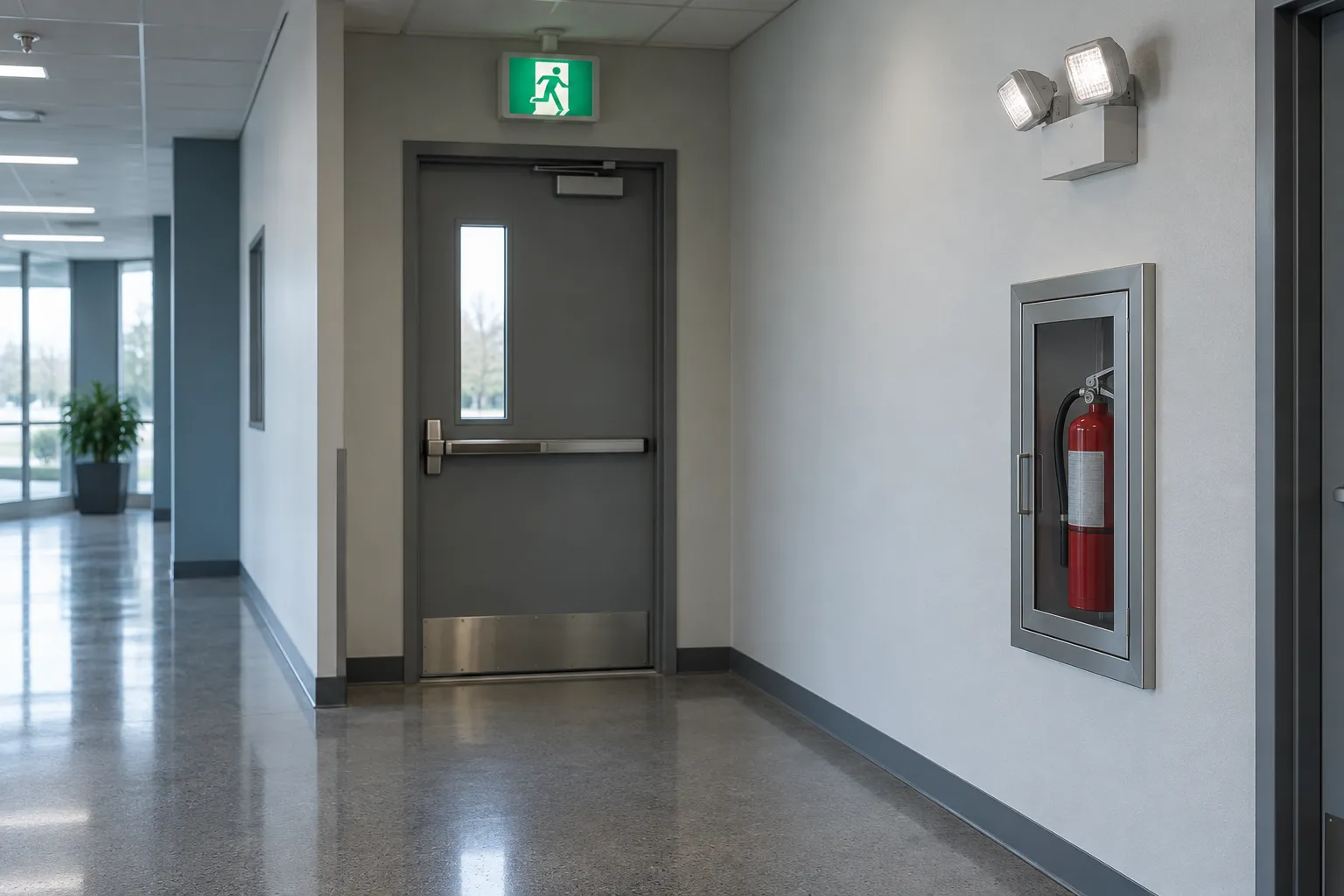
Systems in a typical office building
| System | Usual frequency | Who does it |
|---|---|---|
| Fire alarms | Inspection and test at least once a year; many fire marshals expect a current annual report | Licensed alarm company |
| Fire sprinklers | Weekly or monthly valve and gauge checks, quarterly alarm tests, annual inspection, five-year internal checks | Staff for visual checks; licensed sprinkler contractor for tests |
| Fire extinguishers | Monthly visual check; annual maintenance check with a current tag | Staff monthly; licensed extinguisher company yearly |
| Emergency lighting and exit signs | Exit signs need working backup power; confirm the monthly and annual test routine with your fire marshal | Facility staff or electrician |
| Backflow preventer on the fire line | Often once a year; set by your water utility | Certified backflow tester |
Compliance calendar
Every month
- Look at every portable extinguisher: in place, not blocked, gauge in the green, seal intact, no damage.
- Check that sprinkler gauges read normal and that locked or supervised valves are open.
- Walk the exits: doors open freely, nothing stored in corridors or stairwells, exit signs lit.
Every quarter
- Ask your sprinkler contractor to test the waterflow alarm and inspect the fire department connection.
- Check that the fire alarm panel shows no trouble or supervisory lights, and log the date.
Every 6 months
- Test waterflow and valve supervisory signals if your sprinkler contractor schedules them twice a year.
Once a year
- Book the annual fire alarm inspection and test.
- Book the annual sprinkler inspection, including the main drain test.
- Have every extinguisher given its annual maintenance check and new tag.
- Test the backflow preventer if your water utility requires it.
- Review the emergency action plan with employees and train the staff who help others leave.
Longer cycles
- Run the five-year internal pipe inspection, gauge replacement or calibration and valve interior checks that NFPA 25 sets for sprinkler systems.
- Stored pressure dry chemical extinguishers get emptied and serviced every 6 years and hydrostatically tested on a longer cycle (12 years for the common type).
Get this calendar for your building
Who is responsible: landlord or tenant
The lease decides, so read it. In a multi-tenant office building the landlord usually owns the base-building systems: the fire alarm panel, the sprinkler risers, the fire pump if there is one, and the exit stairs. The tenant usually owns what sits inside the suite: extinguishers, suite exit signs, and keeping storage 18 inches below sprinkler heads.
When a tenant changes the layout, new walls can block sprinkler spray and alarm devices. Tell the landlord before the work starts so the system can be altered and re-tested.
Federal workplace rules also sit on the employer. OSHA requires an emergency action plan in writing, kept at the workplace, covering how to report a fire, how to evacuate, how to account for everyone, and who to ask. Employers with 10 or fewer employees may share it orally. OSHA requires a distinct alarm signal and trained evacuation helpers.
Drills, plans and training
OSHA does not set a drill schedule for general office use. Your fire marshal, insurer or the local fire code may. Ask which one applies and write the answer in your plan.
- Review the emergency action plan with each employee at hire, when their role in the plan changes, and when the plan changes.
- If you give employees extinguishers to use, train them at hire and at least once a year on the basics and the limits of fighting a small fire.
- If a fire prevention plan is required, it lists major fire hazards, waste control, who maintains heat-producing equipment, and who controls fuel hazards.
Permits and occupancy
A standard office usually needs no yearly fire permit, but your city may run a routine inspection program for commercial buildings. Cooking in a break room, server rooms with special suppression, battery rooms and generators can each trigger their own rules. Keep occupant load signs accurate and do not exceed the posted number for assembly spaces such as training rooms.
What the inspector checks
- Exit doors open without a key from inside, and exit paths are at least 36 inches wide.
- Exit signs are lit and have working backup power.
- Extinguishers are mounted, charged, within about 75 feet of travel, and carry a current annual tag.
- Fire alarm panel shows no trouble signals and has a current annual inspection report.
- Sprinkler heads are clean and clear, with at least 18 inches of space below the deflector.
- Electrical panels have clear working space and no storage in front.
- No overloaded outlets or daisy-chained extension cords.
- Fire lanes, hydrants and fire department connections are clear.
Records binder
Keep these on site where the inspector can see them: the annual alarm report, the annual and quarterly sprinkler reports, extinguisher tags and the vendor service record, the written emergency action plan and training sign-ins, and the backflow test report. OSHA requires the annual extinguisher maintenance date to be recorded and kept for one year after the last entry or the life of the shell, whichever is less. Many insurers want three years of reports, so keep that long unless your fire marshal says otherwise.
Office buildings: common questions
How often should an office building have a fire inspection?
Fire marshals commonly aim for a yearly inspection of commercial buildings, but the interval varies by city. The systems inside the building have their own cycle: monthly extinguisher checks, quarterly sprinkler alarm tests and yearly alarm and sprinkler inspections. Confirm your local interval with your fire department.
Who has to inspect the fire extinguishers in an office?
Staff can do the monthly visual check. OSHA requires an annual maintenance check, and most owners hire a licensed extinguisher company to do it and attach the tag.
Is the tenant or the landlord responsible for the fire alarm system?
It depends on the lease. Landlords usually keep the base-building alarm and sprinkler systems, and tenants keep suite equipment such as extinguishers. Put the split in writing.
Does an office need a written emergency action plan?
OSHA requires a written plan when an OSHA standard calls for one. It must be kept at the workplace. Employers with 10 or fewer employees may communicate it orally.
How much clearance do sprinklers need?
Inspectors commonly look for at least 18 inches of open space below the sprinkler deflector. Your local fire code sets the exact number.
What happens if the fire marshal finds a violation?
You get a written notice with a deadline to fix it and a re-inspection. Serious life safety problems can lead to fines or a request to limit occupancy. Ask the marshal what your jurisdiction does.
Requirements depend on the code edition your state and local fire marshal have adopted. Confirm with your authority having jurisdiction.
Sources
- OSHA 29 CFR 1910.38 Emergency action plans
- OSHA 29 CFR 1910.39 Fire prevention plans
- OSHA 29 CFR 1910.157 Portable fire extinguishers
- Koorsen Fire and Security: Fire marshal inspection checklist (secondary)
- Vancouver (WA) Fire Marshal's Office: Fire inspections
- Rimkus: Commercial sprinkler system inspection guide (secondary, summarizes NFPA 25)