Backflow Testing Requirements: Annual Tests and Utility Rules
Backflow testing requirements for a fire sprinkler line usually mean one thing: a certified tester checks the backflow assembly at install and at least once a year, and the report goes to your water utility. The exact rules are set by your state drinking water program and your local water utility, not by one national code, so they vary. NFPA 25 also expects a yearly forward flow test on assemblies in fire lines.
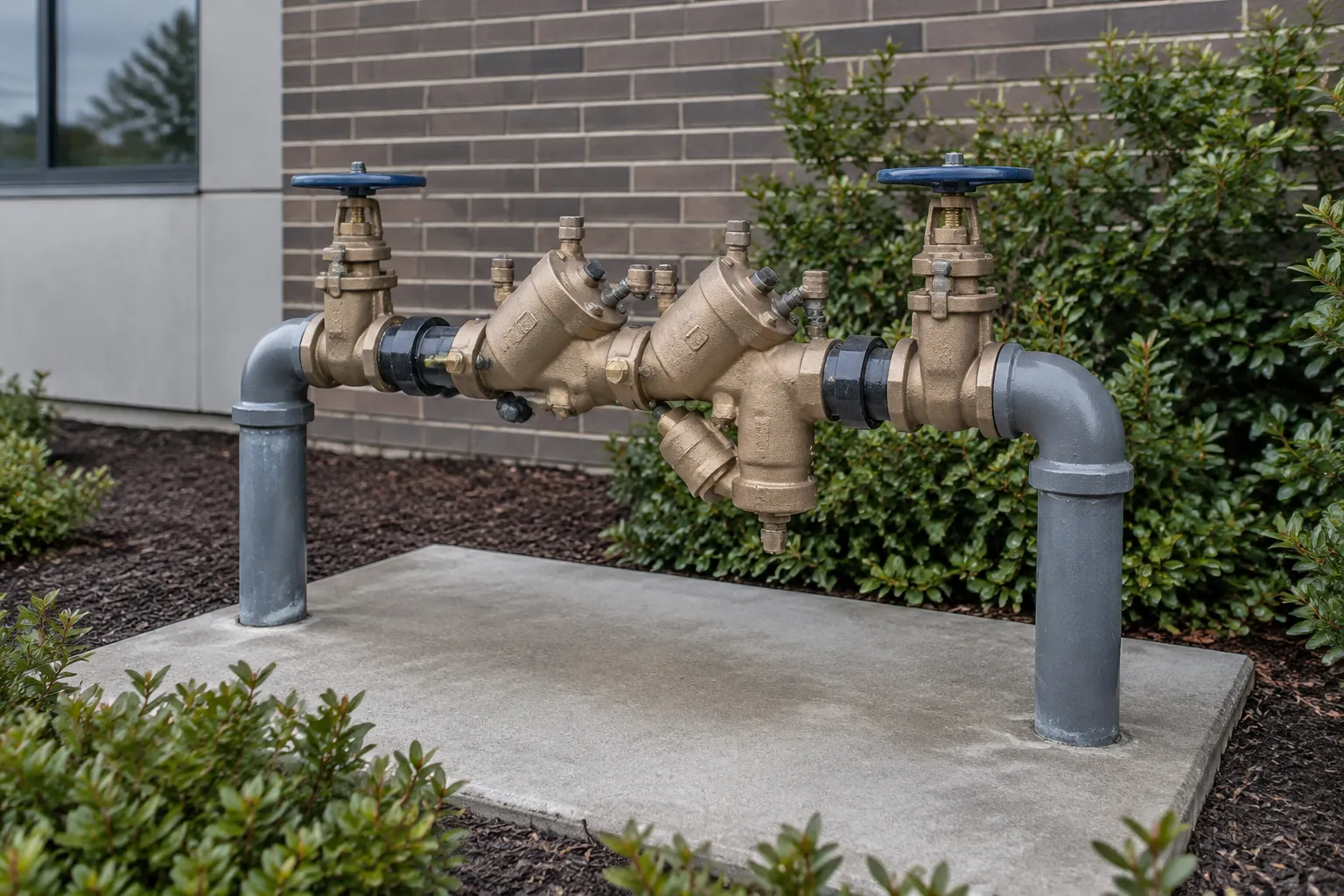
Backflow preventers inspection, testing and maintenance
What to look at
A backflow assembly protects the public water main from the water in your fire line. Inspection is a visual check between yearly tests. Look for leaks from the relief valve port, closed or unsupervised valves, damage and anything stored in the way of the assembly.
- Confirm both shutoff valves are open and sealed or supervised.
- Look for water dripping from the relief valve port on reduced pressure assemblies.
- Check the assembly is accessible and not buried, flooded or blocked.
- Check the tag or label for the date of the last test.
- Confirm the assembly type matches what your utility approved for fire service.
The annual test and the forward flow test
Plumbing codes cited by the City of Phoenix require backflow devices to be tested at installation, repair or relocation and at least annually after that, or more often when the authority having jurisdiction requires. New Jersey and Washington State also require annual testing. The tester must hold a recognized certification, and Phoenix requires a gauge calibrated within the prior 12 months.
Fire lines add a forward flow test. New Jersey’s state bulletin says its annual certificate satisfies the NFPA 25 backflow annual test for dedicated fire lines. Some places split the work: Phoenix says testing downstream of a fire line backflow preventer is the Fire Department’s job.
- Hire a tester who is certified and on your utility's approved list, if it keeps one.
- Schedule the test with your fire sprinkler contractor so the line is shut and restored once.
- Warn your monitoring company and tell the building before the line is shut off.
- Ask for a forward flow test on fire lines where your fire marshal requires it.
- Ask the tester for the gauge calibration date.
- Repair or replace any failed assembly and retest.
Repair and replacement
If an assembly fails, repair or replace it. New Jersey says replacements on fire services must be approved for fire protection use and must not weaken the system, and that a permit is required. Treat any shutoff of the fire line as an impairment: notify the fire department and your insurer.
- Repair or replace a failed assembly before the due date on the utility notice.
- Use only assemblies approved for fire service by your utility and fire marshal.
- Get a permit where your jurisdiction requires one for replacement.
- Retest after every repair.
- Keep a spare test schedule so the test never lapses.
Test reports and deadlines
The owner usually has to file the tester’s report. Phoenix requires an original certified test report on its approved form, submitted by the due date on the work order, with records kept at least 3 years. Incomplete reports are rejected. New Jersey’s sample form lists the assembly type, location, model, serial number, test readings and the tester’s signature.
- File the report with your water utility by the due date on the notice.
- Make sure the report shows assembly type, location, serial number, readings and tester certification.
- Keep copies for at least the period your utility sets (3 years in Phoenix).
- Send a copy to the fire marshal if your jurisdiction asks for it.
- Calendar next year's test when you receive the report.
What the inspector checks
- Test report dated within the last 12 months.
- Tester certification and gauge calibration shown on the report.
- Assembly type approved for fire service.
- Shutoff valves open and supervised.
- No leaking relief valve and no flooding in the vault or room.
- Assembly accessible for testing.
- Forward flow test record on fire lines where required.
Backflow rules vary by utility and state
The US EPA cross-connection manual says the water supplier has primary responsibility for protecting the public system, which is why utilities write their own programs. State drinking water agencies set the base rules and local utilities add to them. A sample ordinance printed in the EPA manual calls for reduced pressure devices to be tested at least semiannually, so annual is common but not universal.
| Source | What it says |
|---|---|
| City of Phoenix, AZ | Test at install and at least annually by a certified tester; calibrated gauge; report to the city; records for 3 years |
| New Jersey DCA Bulletin 99-2 | Test before final inspection and annually; tester certified by an agency recognized by the state drinking water bureau; certificate accepted by fire officials for NFPA 25 |
| Washington State DOH rules | Annual test by a certified backflow assembly tester; customer maintains the assembly |
Call your water utility and ask for its cross-connection program rules before you hire a tester.
Backflow preventers: common questions
How often does a fire line backflow preventer need testing?
At least annually in the Phoenix, New Jersey and Washington State sources reviewed here. Some utilities require more often. Ask yours.
Who can test a backflow assembly?
A tester certified under your state program or recognized by your utility. Many utilities keep an approved tester list and require a calibrated test gauge.
Do I report the test to the fire department or the water utility?
Usually the water utility. Some jurisdictions also accept the certificate for the fire code. New Jersey accepts its certificate for the NFPA 25 backflow test.
What is a forward flow test?
A flow test through the backflow assembly in a fire line to show it passes the required flow. NFPA 25 summaries list it as an annual task for fire line assemblies.
Is there one national backflow code?
No. Rules come from state drinking water programs, plumbing codes and local utilities, with AWWA and EPA manuals as guidance.
What happens if the assembly fails?
Repair or replace it, retest, and file the passing report. Some utilities can shut off service if the problem is not fixed by the notice date.
Does a home or small residential sprinkler need testing?
Some jurisdictions exempt one and two family homes. New Jersey does for testable preventers in one and two family dwellings. Check your utility.
Requirements depend on the code edition your state and local fire marshal have adopted. Confirm with your authority having jurisdiction.
Sources
- Backflow Tester Requirements, City of Phoenix Planning and Development
- Bulletin 99-2 Testing of Backflow Preventers, New Jersey Department of Community Affairs
- Cross-Connection Control Rules and Regulations 331-355, Washington State Department of Health
- Cross-Connection Control Manual, US EPA
- NFPA 25 standard page, NFPA
- Commercial Sprinkler System Inspection Guide, Rimkus