Fire Sprinkler Inspection Requirements: Weekly to Five-Year Tasks
Fire sprinkler inspection requirements come from NFPA 25 and run on a fixed ladder: valve and gauge checks every week or month, alarm and fire department connection checks every quarter, sprinkler and main drain work every year, and internal tests every 3 and 5 years. As the owner you hold the duty even when a contractor does the work. Your state or city sets which NFPA 25 edition applies and who may perform each task.
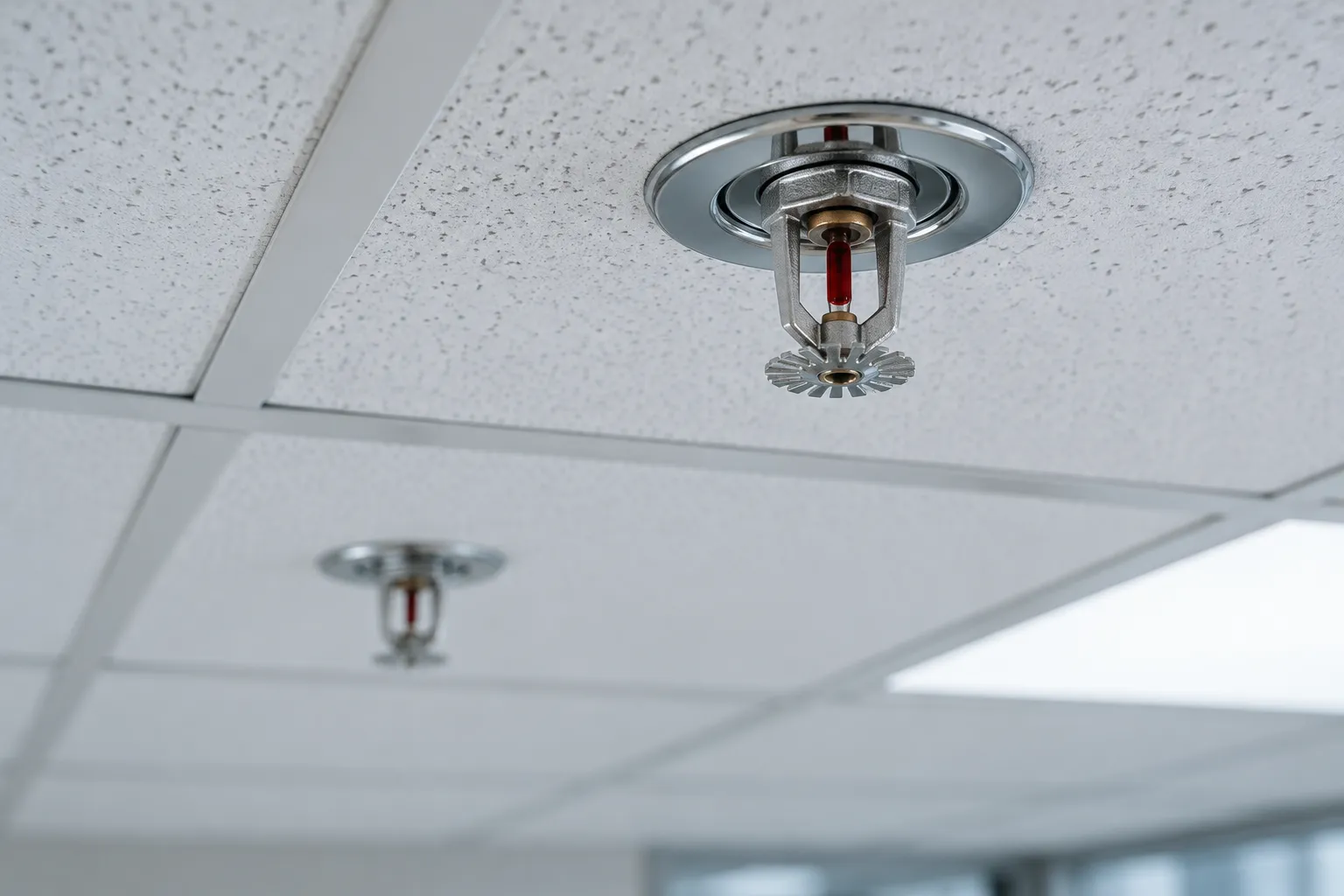
Fire sprinklers inspection, testing and maintenance
What to inspect and how often
Inspection means looking: you check that the system is in place, open, and undamaged. NFPA 25 sets the interval for each part. The intervals below come from public agency and industry summaries of the standard. Gauge intervals differ between summaries and editions, so confirm yours.
Visual checks are usually the part an owner’s trained staff can handle. Sources disagree on exactly which tasks need a licensed contractor, and states differ, so ask your fire marshal.
- Check every control valve is open and sealed, locked or electrically supervised (weekly or monthly, per valve type and edition).
- Read gauges on wet systems and on dry, preaction and deluge systems and note the pressure.
- Look at alarm devices, alarm valve exteriors and fire department connections (quarterly).
- Look at sprinklers, pipe, fittings, hangers, braces and signs for damage, paint, corrosion or loading (annually).
- Count spare sprinklers and confirm the wrench is in the cabinet (annually).
- Check unheated areas and heating before freezing weather (annually).
- Look at the interior of pipe for obstructions on the 5-year cycle.
What to test and how often
Testing means operating the system or a part of it. Test intervals run from quarterly to every 5 years, and several tests need a qualified contractor with the right equipment. Waterflow alarm devices are tested quarterly for mechanical types and semiannually for vane and pressure switch types.
Dry-pipe systems add a yearly trip test and a full-flow trip test every 3 years. Tell the fire department or monitoring company before any test that can send an alarm.
- Run the main drain test and record static and residual pressure (annually).
- Test waterflow alarm devices: mechanical quarterly, vane and pressure switch types semiannually.
- Test valve supervisory signals (semiannually) and operate every control valve through its range (annually).
- Trip test dry-pipe valves annually and run the full-flow trip test every 3 years.
- Test dry-pipe system air leakage every 3 years.
- Test or replace gauges on the 5-year cycle.
- Schedule sprinkler sampling for old or special heads (extra-high temperature types, 5 years) with your contractor.
Maintenance and impairments
Maintenance is the repair and upkeep that keeps the system working between inspections. It includes fixing leaks, replacing damaged or painted sprinklers with the same type, keeping storage clear of sprinklers, and cleaning strainers and filters on their cycle.
When you shut part of a system off, that is an impairment. Summaries of NFPA 25 describe an impairment process: tag the valve, notify the fire department, your insurer and your monitoring company, limit the hazard while the system is down, and restore service as fast as you can.
- Tag every impaired valve and the fire department connection, and notify the fire department, insurer and alarm company.
- Replace damaged sprinklers with the same type, temperature rating and response from the spare cabinet.
- Keep storage and shelving clear of sprinkler deflectors (confirm the clearance with your fire marshal).
- Keep heat on in areas with wet pipe, or confirm freeze protection is in place.
- Service antifreeze loops and check concentration where installed (annually).
- Reseal and lock valves after any work.
Reports and record keeping
Keep a written record of every inspection, test and repair. Reports should show the date, system, task, result, who did the work and any deficiency. Retention periods differ by edition. One industry summary of a recent edition gives the rule as the next occurrence of the task plus one year. An older summary gives one year. Use the longer figure unless your fire marshal says otherwise.
Many cities collect contractor reports through a third-party portal. Ask your fire marshal whether your jurisdiction does.
- Keep dated reports for weekly, monthly, quarterly and annual tasks in one binder or system.
- Keep the 3-year and 5-year reports longer, and keep drawings and hydraulic calculations for the life of the system.
- Record every deficiency and the date it was fixed.
- Record each impairment with start time, end time and who was told.
- Ask the fire marshal if reports must go to a city portal and in what format.
What the inspector checks
- Current inspection and test reports for the right intervals, signed by the person who did the work.
- Control valves open, sealed and tagged correctly, with no closed valve left unreported.
- Gauges in range and present on every system riser.
- Sprinklers free of paint, corrosion, damage and loading, with clear space below.
- Spare sprinkler cabinet stocked with the right types and a wrench.
- Fire department connection visible, capped and unobstructed.
- Impairment tags and notification log if any part is out of service.
- Alarm and monitoring working when a test signal is sent.
NFPA 25 frequency table for sprinkler systems
| Frequency | Typical tasks |
|---|---|
| Weekly or monthly | Control valve position; gauges on dry, preaction and deluge systems; wet system gauges monthly |
| Quarterly | Waterflow alarm devices, alarm valve exterior, fire department connections, supervisory devices, hose valves |
| Semiannual | Vane and pressure switch alarm tests; valve supervisory tests |
| Annual | Sprinklers, pipe, hangers and signs; spare sprinklers; main drain test; control valve operation; dry-pipe trip test |
| 3-year | Dry-pipe full-flow trip test; air leakage test |
| 5-year | Internal pipe inspection; interiors of alarm, check and preaction valves; strainers and orifices; gauge test or replacement |
The table summarizes public agency and industry sources, not the standard. Edition differences exist, for example gauges are monthly in some summaries and quarterly in the contract table. Read NFPA 25 itself or ask your fire marshal before you rely on one interval.
Who is responsible and who can do the work
NFPA 25 puts inspection, testing and maintenance on the property owner. New York State’s fire prevention office says its fire code does not set a certification or third-party requirement for inspectors, it leaves the duty on the owner to use qualified people. Other states and cities do license sprinkler contractors, so check yours before you hire.
For a list of local providers see find a provider.
Fire sprinklers: common questions
How often does a fire sprinkler system need to be inspected?
NFPA 25 sets different intervals by part: weekly or monthly for valves and gauges, quarterly for alarm devices and fire department connections, annually for sprinklers and pipe, and every 3 and 5 years for internal tests. Many fire marshals also expect one annual report.
Can building staff do the inspections?
For simple visual checks, often yes if they are trained. New York State says its fire code does not require a third-party inspector. Other jurisdictions require a licensed contractor. Ask your fire marshal.
What is the 5-year sprinkler inspection?
Every 5 years the internal pipe is checked for obstructions, interiors of some valves are inspected, and gauges are tested or replaced. Plan it with your contractor because it needs the system opened.
What is a main drain test?
You open the main drain valve and watch the pressure drop and recovery to see whether the water supply has changed or a valve is partly closed. It is done annually and recorded.
How long do I keep sprinkler inspection records?
It depends on the edition and your fire marshal. One industry summary of a recent edition says the next occurrence of the task plus one year, and an older summary says at least one year. Keep the longer period.
What is an impairment?
Any time the system or part of it is out of service. Tag the valve, tell the fire department, insurer and alarm company, and restore service quickly.
Which NFPA 25 edition applies to my building?
The one your state or city adopted through its fire code. It is often not the newest. See the fire code adoption report on this site or call your fire marshal.
Requirements depend on the code edition your state and local fire marshal have adopted. Confirm with your authority having jurisdiction.
Sources
- NFPA 25 standard page, NFPA
- Fire sprinkler and fire pump service scope with NFPA 25 tables, East Bay Municipal Utility District
- Campus Fire Safety Bulletin: Sprinkler Inspection & Tests, New York State Department of State
- Commercial Sprinkler System Inspection Guide, Rimkus (industry consultancy)
- NFPA 25 Highlights, Risk Logic (insurance consultancy)