Emergency Lighting Testing Requirements for Buildings
Emergency lighting testing requirements under NFPA 101 call for a functional test of at least 30 seconds every month and a test of at least 90 minutes every year. Battery lights and exit signs must stay fully on for the whole test. Keep written records for your fire inspector.
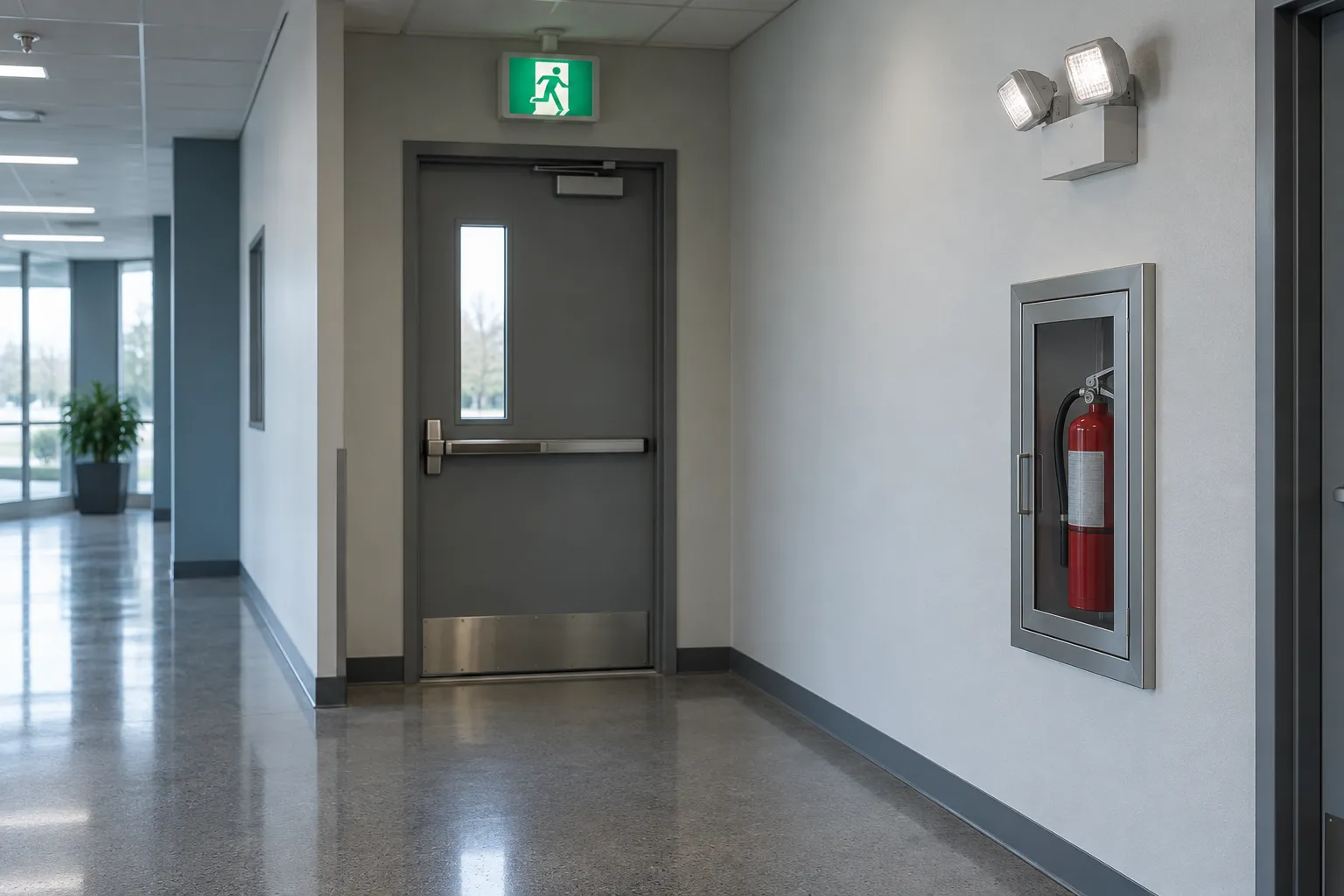
Emergency lighting inspection, testing and maintenance
What to check on emergency lights and exit signs
Walk every exit route. Emergency lights should cover exits, corridors, stairs and the way out of the building. Minnesota Department of Health guidance describes designated exit access and exit discharge areas that need lighting, including stairs, aisles, corridors and ramps.
- Charge indicator lit on each unit
- Lamp heads aimed at the exit path
- Exit signs lit and readable
- No units blocked, covered or unplugged
- Self-test units show no failure indicator
- Cord and plug connections are intact
How to run the 30 second and 90 minute tests
NFPA 101, Section 7.9.3 lets you use three approaches. The first is manual functional testing: a test of at least 30 seconds each month, with 3 to 5 weeks between tests, and a test of at least 90 minutes each year. The equipment must be fully operational for the whole test.
Self-testing units run their own 30 second test and a diagnostic at least every 30 days, show failures with an indicator, and still get a monthly visual check and a 90 minute annual test. Computer-based systems run the 30 second and annual 90 minute tests automatically and keep a history.
Test buttons can hide a failed power-interrupt circuit. Cutting the breaker that feeds the lights is a stronger test, but it also cuts power to the rest of that circuit.
- Monthly: run a 30 second test on every unit
- Annual: run a 90 minute test on every unit
- Confirm each unit stays lit at the end
- Mark failed units for repair
- Plug cord-connected units back in right after the test
Batteries and repairs
Batteries wear out. The Minnesota guide estimates a maintenance-free lead acid battery lasts about 5 to 10 years and a nickel cadmium battery about 10 to 15 years. Test results tell you when to replace them. Follow the manufacturer’s instructions.
- Replace batteries that fail the 90 minute test
- Replace burned out lamps
- Do not add switches that cut power to the unit's normal circuit
- Keep units on the same circuit as the normal lighting for that area
Test records to keep
NFPA 101 requires written records of testing to be kept for the authority having jurisdiction to inspect. Minnesota’s own fire code, as described in the state health guide, asks for records to be kept on site for at least 3 years and to show the unit location, pass or fail, the test date and the tester’s name. Your state or city may use a different period. Confirm with your fire marshal.
- Location of each unit tested
- Pass or fail result
- Date of test
- Name of tester
- Battery replacement dates
What the inspector checks
- Units and exit signs light up on test
- Written monthly and annual test records are on site
- Records show the 90 minute annual test
- Failed units have been repaired
- Egress paths are lit with no dark gaps
Where emergency lighting is required
NFPA 101 and the International Fire Code both require emergency lighting on the means of egress in most occupied buildings. The exact list by occupancy is in your adopted code. Healthcare, assembly, schools, hotels and offices over a set size are common examples. Call your fire marshal for the rule that applies to your building.
Local variations to check
The 30 second and 90 minute cycle is the NFPA 101 baseline. Some state codes set different durations. Minnesota’s state fire code, per the Department of Health guide, uses a 30 minute annual test for existing buildings and a 3 year record period. That is why you should check your own state page before you write your schedule.
Emergency lighting: common questions
How often must emergency lights be tested?
Under NFPA 101, a functional test of at least 30 seconds every month and at least 90 minutes every year.
How long must the annual emergency light test run?
At least 90 minutes under NFPA 101. The equipment must stay fully operational the whole time.
Do exit signs need testing?
Yes, if they have a battery backup. The same monthly and annual cycle applies.
Can self-testing lights replace manual tests?
They replace the manual 30 second test. NFPA 101 still requires a monthly visual check and an annual 90 minute test.
How long do I keep emergency light test records?
NFPA 101 requires written records for the fire official. The retention period varies by state. Minnesota's guide cites 3 years. Confirm yours.
How long do emergency light batteries last?
A Minnesota state guide estimates about 5 to 10 years for lead acid and about 10 to 15 years for nickel cadmium. Test results decide when to replace.
Who can test emergency lights?
Facility staff can run the tests. Many owners hire an electrician or fire protection company for the 90 minute test.
Requirements depend on the code edition your state and local fire marshal have adopted. Confirm with your authority having jurisdiction.
Sources
- Minnesota Department of Health: Maintenance of Battery-Operated Emergency Lights
- Koorsen: testing emergency and exit lights (secondary)
- NFPA 101 standard page