Hospital fire safety inspection
A hospital fire safety inspection checks fire alarms, sprinklers, fire doors, emergency power, extinguishers and the written fire plan against the Life Safety Code (NFPA 101) and the Health Care Facilities Code (NFPA 99) when the facility is certified by Medicare or Medicaid. Nursing homes follow the same CMS codes. Assisted living is usually set by state licensing rules instead.
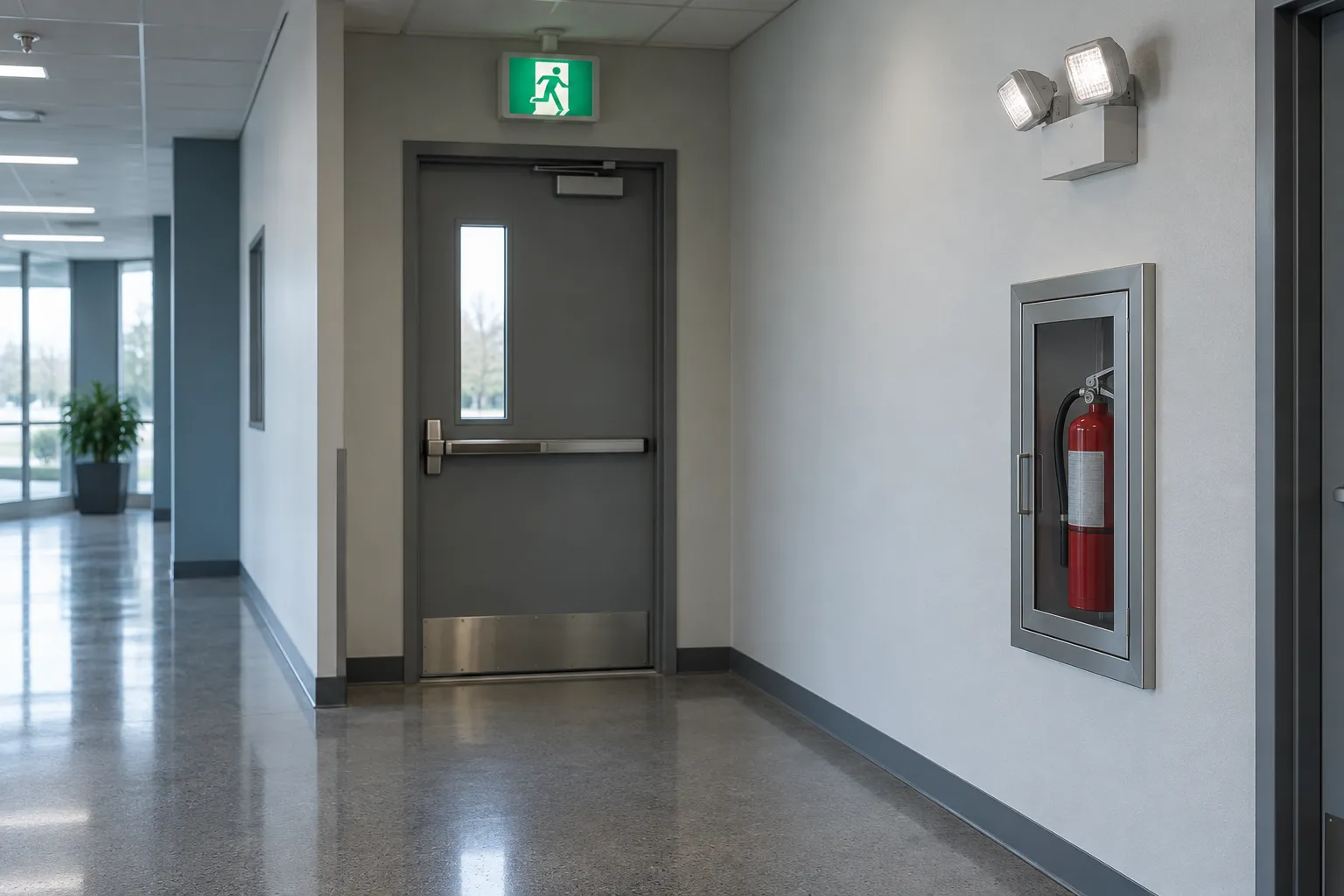
Systems in a typical healthcare facility
| System | Usual frequency | Who does it |
|---|---|---|
| Fire alarms | NFPA 72 inspection and test; Texas assisted living, for one example, requires service at least every six months | Licensed alarm company |
| Fire sprinklers | Weekly to quarterly checks, annual inspection, five-year internal checks; shutdown over 10 hours needs a fire watch or evacuation | Licensed sprinkler contractor |
| Fire extinguishers | Monthly visual check; annual maintenance with a current tag | Staff monthly; licensed company yearly |
| Emergency power and lighting | Required for exits, fire systems and life support; test routine set by NFPA 99 and your surveyor | Facilities engineer or electrician |
| Fire pumps | Weekly or monthly run test, annual flow test | Pump contractor; staff for run tests |
| Kitchen hood suppression | Semiannual service is common; confirm with your fire marshal | Licensed suppression company |
| Backflow preventer on the fire line | Often once a year; set by your water utility | Certified backflow tester |
Compliance calendar
Every month
- Visually check every portable extinguisher.
- Check sprinkler gauges and valve positions.
- Run electric fire pumps at least 10 minutes and log readings.
- Walk corridors: doors latch, no wedges, no storage in exit routes.
Every quarter
- Test sprinkler waterflow alarms and inspect fire department connections.
- Hold the drills your state survey agency or licensing rule requires. Texas assisted living, for example, requires at least one drill each quarter on every shift and at least one each month.
Every 6 months
- Fire alarm service in states that require it twice a year (Texas assisted living is one example).
- Test sprinkler waterflow and valve supervisory signals as your contractor schedules them.
Once a year
- Annual fire alarm inspection and test, with report.
- Annual sprinkler inspection and main drain test.
- Annual extinguisher maintenance and tags.
- Annual fire pump flow test.
- Obtain written evidence of inspection and approval by your state or local fire control agency.
Longer cycles
- Run the five-year internal pipe inspection, gauge replacement or calibration and valve interior checks that NFPA 25 sets for sprinkler systems.
Get this calendar for your building
Which rules apply: CMS-certified or state-licensed
If the facility takes Medicare or Medicaid, CMS conditions of participation apply. For hospitals, 42 CFR 482.41 requires compliance with the Life Safety Code (NFPA 101, 2012 edition with listed interim amendments) and the Health Care Facilities Code (NFPA 99, 2012 edition with listed amendments). Chapters 7, 8, 12 and 13 of NFPA 99 do not apply to hospitals. Outpatient surgical departments must meet the ambulatory health care occupancy provisions regardless of patient count. CMS can waive a provision for unreasonable hardship, and the code does not apply in a state where CMS finds the state code protects patients as well.
Nursing homes follow 42 CFR 483.90 with the same two codes. Assisted living is generally not CMS-certified, so your state licensing agency and local fire marshal set the rules. Many states point to NFPA 101 residential board and care chapters or the International Fire Code. Confirm which edition your state has adopted.
What CMS requires on fire plans, sprinklers and doors
- Written fire control plan: prompt reporting of fires, extinguishing, protection of patients, staff and guests, evacuation, and cooperation with the fire department (hospitals).
- Written proof of inspection: regular inspection and approval by state or local fire control agencies (hospitals).
- Sprinkler outage: if a sprinkler system is shut down for more than 10 hours, evacuate the affected area or set a fire watch until it returns to service. This applies to hospitals and nursing homes.
- Corridor doors: positive latching hardware on corridor doors and doors to rooms with flammable or combustible materials. Roller latches are prohibited (hospitals).
- Emergency power: hospitals need emergency power and lighting in operating, recovery, intensive care, emergency rooms and stairwells. Nursing homes need emergency power for exit lighting, fire detection, alarm and extinguishing equipment, and life support.
- Nursing home sprinklers: automatic sprinklers throughout, tested and maintained under the NFPA 25 edition named in the regulation.
Drills, staff and surveys
Drill frequency for hospitals and nursing homes comes from NFPA 101 as adopted by CMS and is checked by your state survey agency, so ask them for their current drill and testing expectations instead of guessing. For assisted living, state rules can be specific. Texas requires at least one fire drill each quarter on each shift, with at least one each month, documented on the state’s drill report form. Train every new hire on the fire plan, the alarm, and the location of extinguishers and pull stations before they work a shift alone.
What the inspector checks
- Written fire control plan on hand and known to staff.
- Evidence of the latest state or local fire authority inspection.
- Corridor doors close and latch, with no wedges or roller latches.
- Sprinkler system in service, with a fire watch log for any outage over 10 hours.
- Fire alarm tests and annual report current.
- Emergency power and lighting available where required.
- Extinguishers charged, mounted and tagged.
- Exit routes clear, with no storage in corridors.
Records binder
Keep the written fire control plan, drill reports, alarm, sprinkler, pump and extinguisher reports, emergency power test records, fire watch logs and the latest fire authority inspection letter. Survey teams ask for them at the entrance conference, so keep them in one binder or system. Retention periods come from your state and accreditor, so confirm them with your survey agency.
Healthcare facilities: common questions
What codes apply to a hospital fire safety inspection?
For CMS-certified hospitals, NFPA 101 Life Safety Code and NFPA 99 Health Care Facilities Code, both 2012 editions with listed amendments, per 42 CFR 482.41. State and local codes also apply.
Do nursing homes follow the same codes as hospitals?
Yes for CMS certification. 42 CFR 483.90 names the same Life Safety Code and Health Care Facilities Code, and requires sprinklers throughout.
Does CMS regulate assisted living fire safety?
Generally no. Your state licensing agency and fire marshal set the rules. Texas, for example, sets drill, alarm and sprinkler service intervals in its assisted living rule.
What if the sprinkler system must be shut off?
CMS rules say that after 10 hours you must evacuate the affected area or run a fire watch until the system is back. Tell your fire marshal and insurer.
How often do healthcare fire doors need inspection?
The interval is set by NFPA 80 and NFPA 101 as adopted. We have not confirmed it here, so ask your survey agency or fire marshal.
Who inspects a hospital for fire safety?
State survey agencies and accreditors check Life Safety Code compliance, and the local fire authority also inspects. Hospitals must keep written evidence of regular fire authority inspection.
Requirements depend on the code edition your state and local fire marshal have adopted. Confirm with your authority having jurisdiction.
Sources
- CMS 42 CFR 482.41 Hospital physical environment
- CMS 42 CFR 483.90 Nursing home physical environment
- 26 Texas Administrative Code 553.104 Assisted living fire safety
- Rimkus: Commercial sprinkler system inspection guide (secondary, summarizes NFPA 25)
- Koorsen Fire and Security: Fire pump testing and inspection requirements (secondary)
- OSHA 29 CFR 1910.157 Portable fire extinguishers
- NFPA 101 standard page